
Lance Nolley
1902-1991

Lance Nolley was a Layout and art director for Walt Disney and Later for Hannah-Barbera from Dallas, Texas. He is a person whose information is hard to find, his life in his early years was not registered, being only known few little facts about him, such as having lost his mother at 4 and having studied in career would change once being contacted by Disney to hire him thanks to his works.
Lance began working as a newspaper and commercial artist, being remarked for working at Associated Press, which got unstable during the great depression, so he went to work at his home again.
before debuting with Disney in 1937, right in time when Snow White, the studio's first film, was to release, so he was invited to attend the Premiere in Beverly Hills. He got trained in a three month course of drawing where he learned about the importance of human body.
He did not feel pleased with his progress as an animator, so became a layout artist and writer instead. His credit on Disney was attributed to almost every feature film, starting with Pinnochio (1940), with almost almost all the Fox and Cat scenes, and the Pastoral in the experimental animated compilation Fantasia (1940), followed by Fun and Fancy Free (1947) Cinderella (1959), Paul Bunyan (1958, which would be compiled in the 2001 feature American Legends), among others, being Lady and the Tramp (1955) his favorite project in the studio due to the nostalgic feeling and the easy and simple designs that could be extracted from anywhere: streets, buildings, stores, without having to make everything from scratch.

Nolley mentioned he did not quite like some productions like Alice in Wonderland and Sleeping Beauty, due to the different artistic approach they had, which were too jumpy or cold for him, even though he appreciated their result.
His perspective on Walt was that he considered him a direct person. He would say the things as they are, he has the idea from the start and can get where everything was going before anyone can finish up the sentence. Of course, his attitude was tough, but not rude; sometimes he can get mad, but he in most times he controls the situation in a way he just says what he has to say and what it has to be in a polite and passive way, without having to use an inadequate vocabulary to express his anger.
He had worked for the studio until leaving in the early or mid 1960's, when he decided to work for Hannah-Barbera (as many Disney animators, new and old equally) as a layout artist for the Flinstones, Yogi Bear, Quick Draw McGraw, among others. Here, he had experienced many differences from Disney, especially on the technique and the limitations. Obviously, it was attributed to budget, so making rough drafts and pencil tests were ommited to go directly for the final product. The art style is something that is not needed to mention, because it is obvious the simple designs and backgrounds that were done.
Lance would remark that the studio was about pressure with deadlines and quality, there is a need to make episodes fast and without details that would lift an eyebrow on someone, and there is a high chance for this to happen given that they were producing for television. Joe Barbera, who would be the layout director back then, was remarked to be perfectionist with the composition of every shot, and would be approaching the artists at all moments it was needed.
There are brief mentions of him in other interviews with another animators and artists, being for example Jerry Eisenberg from Hannah-Barbera, he would mention he came to the studio because of a big artist layoff on Disney, and HB took advantage from it, and Paul Carlson on Disney, who would appreciate his job in layout in How to have an accident at work (1959), being both interviewed respectively by Don M Youp and Didier Ghez.
His perspective of the strike which happened in 1941 was bitter to say the least. Lance was one of the few who decided to be working at the studio. He was pointed out by many, he saw many relationships crumble by differences, he had seen a permanent mark in the studio, and of course there was one. He mentioned that he was laid off temporarily when the government intervened to swap places between a striker and a non striker (there is little mention about it, only that the government sent a mediator to make both parties agree with each other, maybe this was one of the actions this mediator took in order to have one informer of each side). Meanwhile, he would work with Walter Lantz for six months while the situation was stabilizing a bit more.
I chose Nolley because he had brought me some new insights of how Disney was, new perspectives of how the D and HB worked. He was not very known as I can recall, looking for him online is a rough task, especially when many movie databases where giving incomplete lists of his credits and contributions, but still he was appreciated by many inside and outside the industry, because he understood where each shot, story, was going. He seemed conscious of the dynamic inside the studio, where Disney had to be the one to approve the idea, and still he was amazed of how well he knew where he was going, and despite the differences he had creatively with some projects, he still liked to do his stuff.

Reading his interview with Don Peri let me think about sometimes going with the flow and let time do their stuff. This does not mean we have to wait for the chance, Lance had to do his stuff as best as possible to get opportunities, he had to adapt to what he was told to do, but without rejecting his skills. This is a story about, well, identifying your strenghts, learning from others, and enjoy the process.
After retiring in the late 70's-early 80's, Lance would pass away in Los Angeles, California in 1991.
Les Clark
1907-1979

Les Clark was a lead animator and sequence director who worked from 1927 to 1976 at Walt Disney. Les is not only one of the Disney's Nine old men, a group of the most important animators in the early times of the studio, but he is the first of the group.
Although he was not so
recognized as his partners, and had been assigned the lesser characters and elements in any of the productions he had worked in, he brought an important contribution for animation in general due not only his technique, but also his
determination and will to learn and improve in order to achieve results
that can resonate with audiences. This can be seen on the amount of articles, chapters from books, videos, inside and outside the studio.
Les Clark is the youngest of twelve siblings in Ogden, Utah. He had to work at an early age to bring economic support to his family given that his father got a back injury that stopped him from his job as a carpenter. Les, without hesitation, accepted the task and did his best to help.
Les studied in Venice High school, in Los Angeles, but he decided to give a pause because he had economic issues, he would continue his studies later.
Les met the Disney brothers while he was working on a confectionery Walt and Roy were often going in 1925, when they were about to finish Alice and were about to start with Oswald the lucky rabbit, and Mickey Mouse was not even an idea or thought. Les saw the opportunity and decided to offer his service for their studio two years later.
Walt was impressed by the portfolio Les presented, which included works he had done for a school magazine. Les started right after his graduation from high school.
He, as many of those who were introduced into the industry, started from below, working in the tasks that were tedious for many, such as a camera operator and ink and painter. But his principles would make him take the job in a good way, as he learned to be determined and put your effort.
He debuted in the Studio with Steamboat Willie as an inbetweener in 1928, producing one of the shots in the film, and then he would do his first contribution as a lead animator in one the most iconic Silly Symphonies. Yes!, I am talking about the Skeleton Dance from 1929, he worked in the part where one skeleton uses other as a Xylophone.
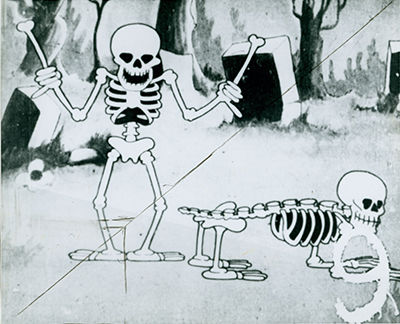
I love you, Xylophone skellies <3
Ok, serious again, Walt did see Les's take in Mickey Mouse as the best in comparison from other animators in the studio, so he was being assigned more works involving the character, giving him a charming personality with each movement and giving a more appealing approach, to the point he would be recognized as the Mickey Mouse Master.
One of the things Les notices when working with the mouse, was that Mickey would look stiff if all the time he had the same shape in head and ears when moving, so making alterations to the shape in a given moment and then return it to its original shape would make the trick.
As an additional note, Les saw Walt in Mickey, which can be a curious analogy, but this can be attributed most to the fact of how Walt was giving his proposals to his employees for films, shorts, you call it. Also, Les perceived that Disney did not see Walt Disney as himself, but an omnipresent entity, an organization, where everyone was working in rather than the credit of his persona. It is a bit odd analogy, taking in mind the strike at the studio, but let's say it is about a thing with perspectives.
Les would have the honor to contribute in Snow White (1937), being the animator of some of the dwarves, specifically Sneezy, Happy, Grumpy and Bashful. One of the scenes Clark got to work with was when Snow White was dancing with the Dwarves. While the protagonist was animated with a live action reference, the Dwarves got to be drawn from imagination, camera angles, perspectives, face expressions, the movements, it sounded as a hard task at the time, but Les managed to animate them in the quality it was required.
One of his most outstanding works would come in The Sorcerer's apprentice Fantasia (1940). This is where he shown his attention to detail, especially for clothing. This can be seen in the way he animated Mickey's coat, which could correctly set the weight on it, with the follow through movements, the folds when being compressed, the movements Mickey was limited to do in some way. That led Les to observe and analyze, and find the possibilities to bring up a believable sequence so audiences can feel the elements.


His other works he would be credited as an Animator for characters and scenes after that would be in majority of the studio's feature films such as Dumbo, Peter Pan, The sword and the Stone, Saludos amigos, Alice in Wonderland, 101 dalmatians (a.k.a. The night of the cold noses in an old spanish translation), to mention some, including many educational shorts such as Donald in Mathmagic Land.
When the Disney strike happened, Les's perception was neutral, as he did not want to give too much weight to it, he just worked in the studio while seeing some of his friends getting mad at him for not being part of the cause. He simply thought he was doing the thing he considered right while everyone were doing the thing they considered right, according to his words.
Clark for me was an interesting person because of the decisions he made, he only looked forward and everything else outside was only a circumstance. He was very passionate about his works, looking the things in a realistic way, doing his best to take the situation directly, reacting in a professional way.
Even though the Disney strike that happened in the 1941 can be justified in some aspects, I have learnt that someone decides his own merits without having to press ourselves to satisfy others. A cause is something that comes from you, other people will have similar intentions as you and other more will not agree with you. The thing is to not force others nor make them feel guilty for their choice, and not try to choose what others had chosen.
Walt Disney and Les Clark during a discussion in the animation of the "Wonderful world of Color" in 1961, image from https://tessa2.lapl.org/digital/collection/photos/id/30720
Clark of course was intending to please Walt with his job, but he wanted to proof what he was capable of in an organic way, without any obsession or blind expectation, he was objective and neutral with his way to perceive his surroundings. He wanted to go his own way to improve, to succeed, it is said that he attended a night art class after working all day to improve his technique.
Of course, he had to adapt himself in the environment, but that is something we have to do not because we have to hide ourselves, but to promote a healthy collaborative environment where everyone can come to the same conclusion with satisfaction.
Les Clark, after retiring in 1976, he would pass away in September 12, 1979. Later, he would receive the Disney Legend in 1989 and the Winsor McCay award in 1992.
Reflection
I don't think Walt Disney is the perfect role model, he of course has done things that does not sound ethical or moral, such as not giving a good job condition nor credit to his employees, and did some mistakes that could have lowered the studio's status.
But he had a vision and decided to work hard for it, he was one of few the people that wanted the animation medium were not just a passenger trending people would forget once the sensation goes obsolete. He was someone who wanted his world to grow high, he had ambitions and ideas that could inspire others.
I do not say that we need to say thanks to him, this is an article to talk about the evolution of a company, and it can be proved with the experience with both, in the end, Walt used the money he earned for the studio to grow, and nothing else.
References:
-Frank Thomas, Ollie Johnston (1981), The Illusion of Life: Disney Animation, Walt Disney Productions, October 30 2024, digital scan, pages 128, 170
-Don Peri (2008), Working With Walt: Interview with Disney Artists, University Press of Mississippi, October 18 2024, pages 119-133, digital print, https://www.google.ca/books/edition/Working_with_Walt/KUuN3bLD_NoC?hl=en&gbpv=1&dq=working+with+walt&printsec=frontcover
-Tracie Timmer (2017), The first of the Nine: Les Clark, October 30 2024, https://www.waltdisney.org/blog/first-nine-les-clark
-Disney D23, Les Clark, October 30 2024, https://d23.com/walt-disney-legend/les-clark/
-Disney D23, Jim Fanning, Andreas Deja (2017), Les Clark: The Mickey Mouse Master, October 30 2024, https://www.youtube.com/watch?v=G_APxNm5pCw
-Mathew Dominguez (Circa 2021), Where Dreams Come True?: The Impacts of the 1941 Animators’ Strike, pages 14 and 15, October 30 2024, https://www.calstatela.edu/sites/default/files/vol49_matthew_dominguez_disney.pdf
-Don M. Yowp (2015), Layout Lance and Hanna-Barbera Perfection, October 31 2024, https://yowpyowp.blogspot.com/2018/09/layout-lance-and-hanna-barbera.html
-Internet Movie Database, Lance Nolley, October 31 2024, https://www.imdb.com/name/nm0634486/
-Don Peri (2011), Working with Disney : Interviews with Animators, Producers, and Artists, University Press of Mississipi, pages 73-85, digital print, https://www.proquest.com/docview/2131729757/bookReader?accountid=37673&sourcetype=Books
-The Movie DB, Lance Nolley, October 31 2024, https://www.themoviedb.org/person/115759-lance-nolley?language=sv-SE
- Kevin Sandler, Tyler Solon Williams, Don M Yowp (2024), Hanna and Barbera: Conversations: A few words from Jerry Eisenberg, University Press of Mississipi, October 30 2024, https://books.google.ca/books?id=d94BEQAAQBAJ&pg=PT39&dq=lance+nolley&hl=es&newbks=1&newbks_redir=0&sa=X&ved=2ahUKEwjo9Z-D5LiJAxXxle4BHSduMV0Q6AF6BAgLEAI#v=twopage&q=lance%20nolley&f=false
-Didier Ghez (2010), Walt's People -: Talking Disney with the Artists who Knew Him, Volumen 9, Xilibris, page 239, https://books.google.ca/books?id=zOzpwaDTR2wC&pg=PA239&dq=lance+nolley&hl=es&newbks=1&newbks_redir=0&sa=X&ved=2ahUKEwj14MyJ5LiJAxXfJkQIHSnhAF84ChDoAXoECAUQAg#v=onepage&q&f=false